🏛️ Pompeii (Italy)
🔎 Quick Facts and Why It Matters
Pompeii is an ancient Roman city preserved by volcanic ash, known globally for providing a vivid snapshot of life before the catastrophic eruption of Mount Vesuvius in 79 AD.
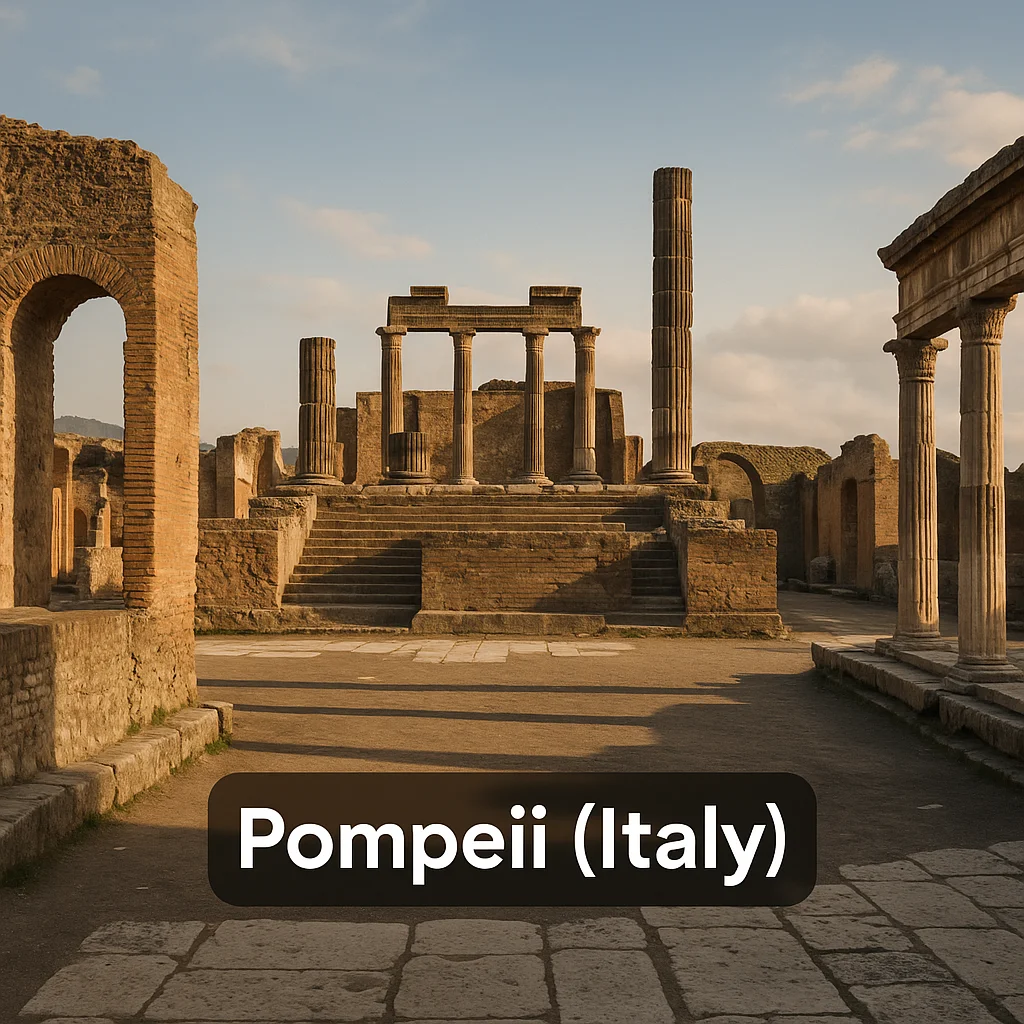
The city is special due to its remarkable preservation, offering visitors the chance to walk through a complete Roman city with streets, homes, baths, and even graffiti visible today. This walkable ruin immerses visitors in history.
Visitors can expect to explore surviving streetscapes, view household artifacts, and enjoy the open-air museum atmosphere. This guide will help you navigate the highlights, learn about its history, and plan a respectful visit.
- Country/Region: Italy, Campania
- General Era: 1st century AD
- Typical Visit Length: 3-5 hours
- Difficulty: Moderate, with uneven terrain
- Best Season: Spring and Autumn
- Highlight: The Forum and amphitheater
🗺️ Where It Is and How to Orient Yourself
Pompeii is located in southern Italy, near the city of Naples, in the region of Campania. It sits at the base of Mount Vesuvius, offering a dramatic backdrop to the ancient ruins.
The nearest major city is Naples, which serves as the typical gateway via its international airport and train station. From there, Pompeii is accessible as a day trip with good planning.
Mentally picture the site in a fertile coastal plain, with the imposing Vesuvius to the northeast and the shimmering Tyrrhenian Sea in the west. This setting emphasizes the contrast between its beauty and tragic history.
🕰️ History in a Nutshell
Pompeii was originally founded by the Oscans before becoming a Roman city around the 6th century BC. It flourished as a commercial hub with bustling streets and vibrant public life.
The city peaked during the Roman Empire, known for its luxurious villas, baths, and amphitheater. However, a devastating eruption of Mount Vesuvius in 79 AD buried it under a thick layer of ash, preserving it in time.
The ruins of Pompeii lay hidden for centuries until rediscovered in the 18th century. The volcanic ash acted as a protective barrier, allowing structures, artifacts, and even organic materials to survive remarkably well.
⭐ Top Highlights You Should Not Miss
- The Forum
- The Amphitheater
- The House of the Vettii
- The Lupanar (ancient brothel)
- The Villa of the Mysteries
- The Stabian Baths
The Forum was the heart of public life in Pompeii. This rectangular plaza offers a wide view of the city’s communal life, with surrounding temples and buildings all fully visible, offering fantastic photo opportunities.
The Amphitheater is a grand monument showcasing Roman engineering. Built to accommodate thousands, its entire structure is visible, making it a focal point for understanding ancient entertainment.
The House of the Vettii is renowned for its elaborate frescoes. Its courtyard is perfectly framed for photos, showcasing the opulence of Pompeian urban villas.
The Lupanar provides insight into the private aspects of Pompeian life. It remains intact, presenting unique wall paintings and individual rooms typical of Roman social dynamics.
The Villa of the Mysteries, on the city’s outskirts, is famed for its frescoes depicting mysterious rituals. The wide view of the villa offers a serene setting against the backdrop of Vesuvius.
The Stabian Baths remain one of the best-preserved bath complexes, showing typical bathing culture complete with full views of dressing rooms and bathing areas.
🧱 Architecture, Materials, and Design (Made Simple)
Pompeii’s structures primarily use materials such as locally sourced volcanic stone, brick, and mortar, combined with some wooden elements. Roman architectural styles dominate, featuring arches, columns, and open courtyards.
The use of arches and vaulted ceilings in public buildings demonstrates Roman engineering brilliance, while colorful frescoes and mosaics illustrate everyday life and mythology.
Unique details, such as the city’s detailed road system including stepping stones to cross streets and public water fountains, underline the advanced urban planning typical of Roman cities.
Restoration efforts ensure that original elements stay preserved, with care taken to maintain the authenticity of both structural and decorative aspects.
🎟️ Visiting Guide (Time, Tickets, and What to Expect)
A standard visit to Pompeii can last 3-5 hours, though a quick visit is possible if time is limited. For those wishing to explore in-depth, consider spending a full day.
Entrance typically requires a ticket, which can often be combined with other nearby archaeological sites for a broader experience. Guided tours are available for richer historical context.
Pompeii generally opens in the morning and closes in the late afternoon, with variations across seasons. Always verify timings before visiting, as they are subject to change.
First-time visitors should aim to arrive early, bring water, wear comfortable shoes, and plan for shade or a hat, given the exposure and heat common in the area.
🚆 How to Get There and Move Around
Visitors can reach Pompeii via trains from Naples, using a route that offers frequent connections and an entrance near the Porta Marina station. Self-driving is also an option, with parking available near main entrances.
Accessibility within Pompeii can be challenging; the ancient cobblestones and slopes require caution. A main route suitable for wheelchairs covers major highlights.
🌤️ Best Season, Weather, and Time of Day
The best seasons to visit Pompeii are spring and autumn, when temperatures are milder and crowds are generally smaller, enhancing the viewing and exploring experience.
For optimal photography and comfort, arrive early in the morning or in the late afternoon. This timing ensures softer lighting and more enjoyable temperature conditions.
In case of rain, visitors may consider exploring the nearby archaeological museum in Naples, which holds artifacts from Pompeii, providing a warm and informative shelter.
⚠️ Safety, Rules, and Respectful Etiquette
Wear sturdy shoes suitable for traversing uneven ground and steps. Given the often hot climates, comfortable, weather-appropriate clothing is recommended.
Respect sacred spaces and follow signage requesting silence in particular areas, ensuring the experience remains respectful for all visitors.
Photography is allowed in general terms, but flash and drone use may be restricted in certain areas. Always adhere to posted rules to avoid disturbances and potential fines.
Please remain on designated paths to help conserve the site and prevent accidental damage. Refrain from touching fragile carvings and ancient surfaces.
Be aware of stone steps that can become slippery when wet, and remain vigilant in crowded areas to deter pickpockets without creating anxiety.
🗺️ Nearby Places and a Simple One-Day Itinerary
After exploring Pompeii, visitors can enrich their experience with several nearby sites.
- Morning: Begin at Pompeii, exploring major highlights
- Midday: Visit Herculaneum, another preserved Roman town
- Afternoon: See the Naples Archaeological Museum
- Evening: Relax with dinner in Naples and stroll by its waterfront
This itinerary allows a flexible yet immersive glimpse into the ancient world, balancing outdoor exploration with cultural enrichment in urban settings.
🧩 Stories, Myths, and Common Questions
Q: Was Pompeii suddenly lost and forgotten?
A: Although buried suddenly, Pompeii's existence was known to locals due to its proximity and stories passed through generations.
Q: Did everyone perish in the eruption?
A: Many residents escaped, but the rapid eruption caught many off guard, preserving their forms in poignant casts, highlighting the scalability of escape.
Q: Is the entire site accessible to children?
A: While some areas may be challenging, much of Pompeii is suitable for family visits with a little preparation.
Q: Is hiring a guide worthwhile?
A: A guide offers deep insights, bringing the ruins to life in ways that can be richer than self-guided tours, especially for first-time visitors interested in history.
📌 Summary and Who This Site Is Best For
- An ancient Roman city preserved in volcanic ash
- Located in Campania, Italy, near Naples
- Known for its daily-life insight before 79 AD eruption
- Top highlights include The Forum, The Amphitheater, The Villa of the Mysteries
- Features Roman architecture with volcanic stone materials
- Recommend visit: 3-5 hours to full day
- Best visited in spring or autumn for mild weather
- Respectful visiting includes staying on paths, respecting signs
- Nearby add-ons: Herculaneum, Naples museum
- Famous for vivid frescoes and preserved streets
Packing history and nature together, Pompeii is a treasure for families, photographers, and history fans alike. The site’s preservation and vivid depictions of Roman life make it a noteworthy visit.
Witness the crossroads of nature’s power and human ingenuity by visiting this remarkable site. Our guide aims to make your journey memorable and responsible.
Explore, learn, and respect Pompeii’s historical narrative. Enjoy your adventure into antiquity.