🏛️ Aït Benhaddou (Morocco)
🔎 Quick Facts and Why It Matters
Aït Benhaddou is a renowned ksar (fortified village) in Morocco, celebrated for its unique clay architecture and historical significance as a caravan stop along the ancient trade route between the Sahara and Marrakech.
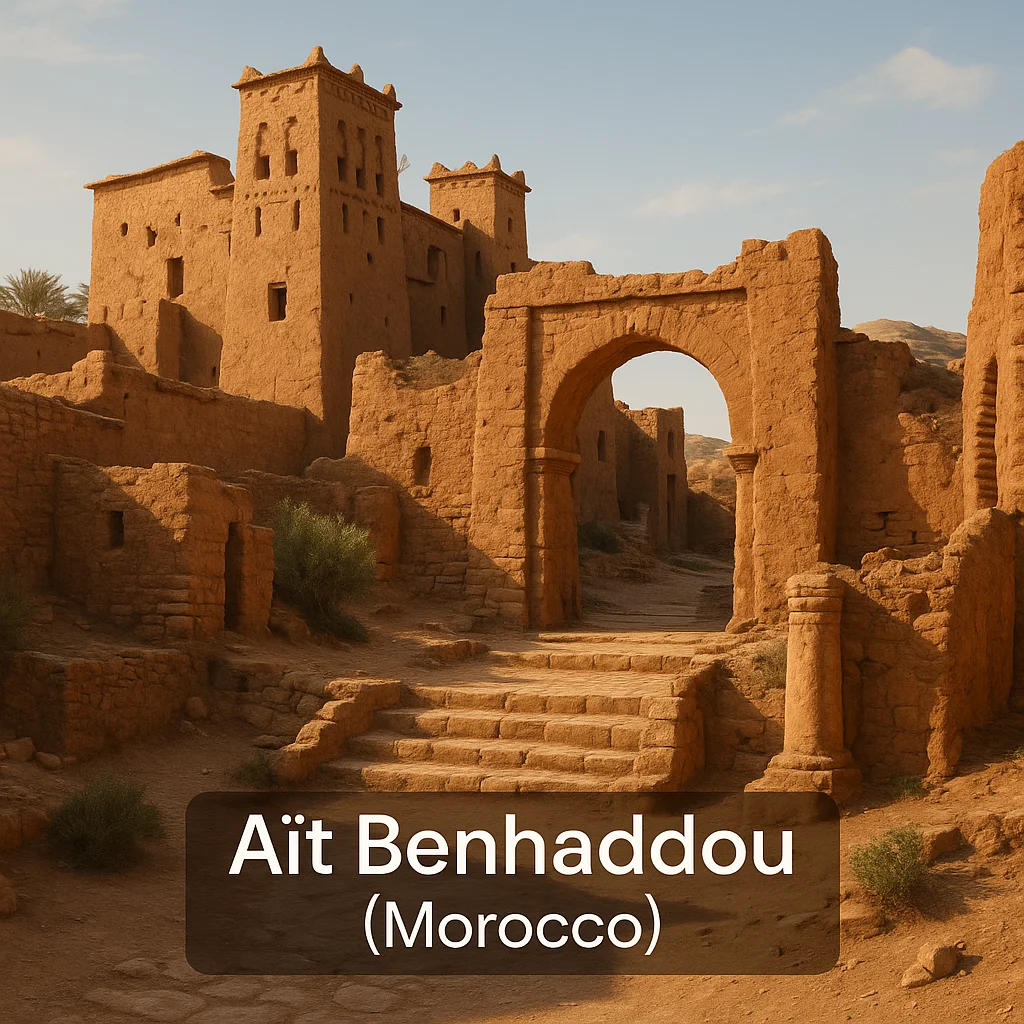
This UNESCO World Heritage Site offers visitors a chance to explore ancient earthen architecture, diverse views, and has been a filming location for many famous films, providing a scenic backdrop that immerses you in history.
In this guide, you'll learn about the origins of Aït Benhaddou, what to see while visiting, and practical advice for making the most of your trip.
- 🌍 Country: Morocco
- 🗓️ Era: 17th century; site possibly older
- 🚶 Typical Visit Length: 1–3 hours
- 🌦️ Best Season: Spring and Fall
- 🏰 Highlight: Kasbahs and panoramic viewpoints
🗺️ Where It Is and How to Orient Yourself
Aït Benhaddou is located in the south-central region of Morocco, in the foothills of the High Atlas Mountains. It lies approximately 30 kilometers northwest of the city of Ouarzazate.
The nearest major gateway is Marrakech, from where Ouarzazate is commonly accessed. From Ouarzazate, the ksar is a short drive, making it a feasible day trip or part of a longer Sahara desert excursion.
To picture its setting, imagine a valley flanked by the desert on one side and mountains on the other, providing a dramatic and isolated atmosphere that enhances its historical charm.
🕰️ History in a Nutshell
Aït Benhaddou was constructed by the Berbers in the 17th century, although some evidence suggests earlier settlements. Historically, it served as a fortified village providing refuge and facilities for traders traveling the trans-Saharan trade route.
During its peak, it thrived as a center of commerce and caravan halal. Over time, shifts in trade patterns and economic decline led to its gradual abandonment. Today, it's primarily a tourist attraction.
Its resilience and preservation were aided by its construction style, using clay and straw, which blends seamlessly with the landscape and withstands the test of time with careful maintenance.
⭐ Top Highlights You Should Not Miss
- Ksar Fortifications
- Granary and Watchtower
- Main Gate
- Traditional Houses
- Viewpoints over the Ounila River
The fortifications, with their distinct earthen walls and solid gates, exemplify traditional Berber defensive architecture. As you approach, you'll see the full structure within its wide surroundings, with the High Atlas Mountains as a backdrop.
The granary and watchtower offer panoramic views across the parched landscape, emphasizing both the strategic advantages and aesthetic beauty of the site.
The main gate is a crucial entrance that tells tales of traders from long ago, and its intact design serves as an entry into the labyrinthine pathways inside.
Traditional houses within the ksar display a simplistic yet functional construction style. A wide view across the rooftops from any raised angle within the village offers excellent photographic opportunities.
The viewpoints over the Ounila River give context to the location’s historic importance, providing full visibility of the winding river and the natural defense it offers.
🧱 Architecture, Materials, and Design (Made Simple)
The ksar of Aït Benhaddou is constructed primarily from local earthen materials—rammed earth, clay bricks, and wood. This method ensures that the buildings remain cool in the intense desert heat.
The architectural style shows clear Berber influences: compact, rectangular buildings, robust walls, and flat roofs. Key features include the kabash or clay-molded towers that punctuate the skyline.
Despite restoration efforts, which have used traditional methods to reinforce the structure, many original features remain, particularly in the less-trodden corners of the site.
🎟️ Visiting Guide (Time, Tickets, and What to Expect)
Visitors typically spend 1 to 3 hours exploring Aït Benhaddou. Entry to the village itself is free, although some buildings may charge a small tourism fee.
The ksar is accessible year-round, generally open from morning to late afternoon. The best approach is to visit early in the day to avoid crowds and midday heat.
For a comfortable visit, wear sturdy shoes, bring water, and consider a sunhat. Guided tours are available, offering deeper insights into the history and architecture.
🚆 How to Get There and Move Around
You can reach Aït Benhaddou from Marrakech or Ouarzazate by bus, car hire, or private taxi. The drive between Ouarzazate and Aït Benhaddou takes about 30 minutes over a scenic route.
Walking through the site involves uneven paths and some steep steps, so be aware of accessibility challenges. For first-time visitors, entering through the main gate offers a straightforward introduction.
🌤️ Best Season, Weather, and Time of Day
The most pleasant months to visit are during spring (March to May) and fall (September to November), offering mild temperatures ideal for exploration.
Sunrise and late afternoon provide the best lighting for photographs, with the low sun casting dramatic shadows that highlight the textures of the clay structures.
If rain threatens, consider visiting indoor exhibits in Ouarzazate like the Cinema Museum or relaxing in one of the local kasbah cafes.
⚠️ Safety, Rules, and Respectful Etiquette
The uneven ground means sturdy walking shoes are vital. Loose-fitting clothing suits both the warm climate and cultural norms.
Respect the environment by following marked paths and avoiding touching or climbing structures to preserve the fragile clay work.
Photography is generally allowed, but drone use and flash photography may be restricted, so adhere to local signage.
Remain aware of your surroundings, as popular sites can become crowded, and always secure personal belongings to avoid pickpockets.
🗺️ Nearby Places and a Simple One-Day Itinerary
Nearby attractions offer further exploration into Moroccan culture and history. Consider visiting:
- Kasbah Taourirt in Ouarzazate
- Fint Oasis for a natural retreat
- Telouet Kasbah for another historical perspective
- Marrakech’s vibrant souks and palaces
For a one-day itinerary:
- Morning: Set off early to Aït Benhaddou, exploring its highlights.
- Midday: Engage with a guided tour detailing its history and architecture.
- Afternoon: Travel back to Ouarzazate, visiting the Cinema Museum.
- Evening: Enjoy a traditional Moroccan meal in a local restaurant.
🧩 Stories, Myths, and Common Questions
There's a myth that Aït Benhaddou was a pivotal "lost city" of gold traders. Historians clarify it was never "lost" but merely fell out of economic favor with changing trade routes.
Some visitors ask if a guide is necessary. While not required, knowledgeable guides enrich the experience by illuminating the ksar's history and cultural nuances.
Families inquire if the site is child-friendly. While the climb can be challenging, children generally enjoy the adventure, provided they are supervised.
📌 Summary and Who This Site Is Best For
- Ksar named Aït Benhaddou
- Located in Morocco’s High Atlas region
- Key takeaway: Historical trade route stop
- Highlights: Fortifications, granary, river views
- Architecture: Clay, Berber style, minimal restoration
- Visit length: 1-3 hours typically
- Best season: Spring or Fall for pleasant weather
- Etiquette: Respect paths, avoid touching structures
- Nearby: Kasbah Taourirt, Fint Oasis
- Memorable fact: UNESCO World Heritage Site
Aït Benhaddou is ideal for history enthusiasts, photographers, and cultural explorers seeking insight into ancient trade life and Moroccan architecture. Its stunning vistas and historical context make the journey worthwhile.
Enthusiasts of film history may also appreciate its cinematic legacy. Whether you’re planning a detailed exploration or a quick stop, respectful visiting enhances the experience for all.
This site offers a serene glimpse into a bygone era, reminding us of the enduring impact of ancient trade routes and architectural ingenuity.