🏛️ Carcassonne (France)
🔎 Quick Facts and Why It Matters
Carcassonne is a medieval fortified city located in southern France, renowned for its comprehensive defensive walls and rich history. These well-preserved walls offer visitors an immersive experience into medieval life.
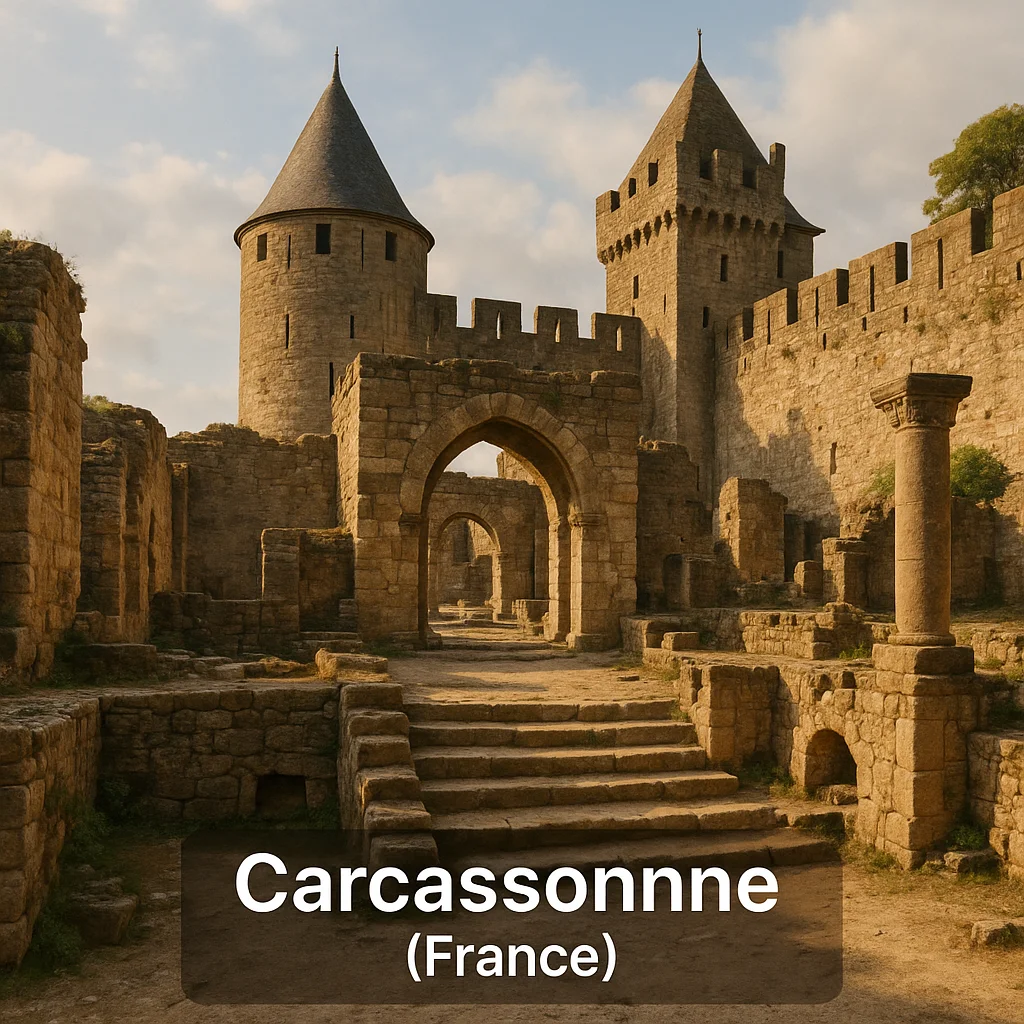
The city is special for its dual wall system that has protected it for centuries. Walking through these historic walls, visitors can enjoy panoramic views and explore cobblestone streets filled with shops and restaurants.
In this guide, you'll learn about Carcassonne's historical significance, its unique architecture, and the best way to approach a visit for maximum enjoyment.
- Location: Southern France, Occitanie region
- Era: Notably fortified in the 12th and 13th centuries
- Typical Visit Length: 2-4 hours
- Difficulty: Moderate; walking required
- Best Season: Late spring and early autumn
- Highlight: The Double-Walled Fortifications
🗺️ Where It Is and How to Orient Yourself
Carcassonne is situated in the Occitanie region of southern France, known for its beautiful landscapes and vibrant culture. The nearest major city is Toulouse, which serves as an accessible gateway for visits to Carcassonne.
Reaching Carcassonne is convenient via train or car from Toulouse. While it is possible to visit as a day trip, staying overnight allows for a more leisurely exploration, especially when considering the quaint charm of the city at dusk.
Envision Carcassonne on a hill, dominating the local landscape, with its impressive walls overlooking the Aude River, providing a strategic vantage point used throughout history.
🕰️ History in a Nutshell
The foundations of Carcassonne date back to Roman times, but it was during the 12th and 13th centuries that the city gained prominence as a fortified stronghold.
Carcassonne served primarily as a fortress, defending the region from invasions. During its peak, it was an essential military and trade hub in medieval Europe.
Its decline began as military strategies evolved, reducing the need for such fortifications. Efforts to preserve the city started in the 19th century, led by architect Eugène Viollet-le-Duc.
⭐ Top Highlights You Should Not Miss
- The Double-Walled Fortifications
- Château Comtal (Count’s Castle)
- Basilica of Saints Nazarius and Celsus
- The Narbonne Gate
The Double-Walled Fortifications are the most famous aspect, offering a dramatic full structure visible from the surrounding countryside. Photography is best from the outer wall, capturing both wall layers and the sprawling landscape.
The Château Comtal provides insight into medieval castle life. A tour here reveals intricate stonework and commanding views from the ramparts.
The Basilica of Saints Nazarius and Celsus is notable for its blend of Romanesque and Gothic architecture, with stunning stained-glass windows.
The Narbonne Gate serves as the main entrance to the city and is a great spot to capture wide views with the entire façade in the frame.
🧱 Architecture, Materials, and Design (Made Simple)
The fortifications of Carcassonne were constructed with local sandstone, creating a cohesive appearance with the surrounding landscape. The walls showcase medieval military architecture with influences from Roman and Gothic styles.
Unique features include the well-preserved battlements, corner towers, and machicolations—openings used for defense. While much of what stands today has been restored, care was taken to maintain the authenticity of the original design.
The restoration by Viollet-le-Duc was controversial; however, it is largely agreed upon that it saved the city from further decay.
🎟️ Visiting Guide (Time, Tickets, and What to Expect)
Plan for a visit of 2 to 4 hours, depending on the depth of exploration. Entry to the city is free, but access to certain areas like the Château Comtal may require a ticket. Guided tours are available for those interested in detailed history.
The city typically opens in the morning with closing around sunset, though this can change seasonally. Arrive early to avoid crowds, particularly in summer months, and consider a hat and water due to limited shade.
The layout allows for a leisurely stroll, with key points easily accessible without the need for a fixed schedule.
🚆 How to Get There and Move Around
Travelers can reach Carcassonne by train from Toulouse or by car via well-marked roads. Once inside, the city is navigable on foot with a compact and manageable size, though the cobbled streets can be uneven.
The main entrance is through the Narbonne Gate, which provides a straightforward route ideal for first-time visitors. Steep sections exist, so comfortable walking shoes are recommended.
Those with mobility concerns may find some areas challenging but can enjoy views from outer paths and access viewpoints near entrances.
🌤️ Best Season, Weather, and Time of Day
The best times to visit are late spring and early autumn when the weather is mild, and tourist crowds are smaller. Summer can be warm and busy, yet the long daylight hours offer more time for exploration.
For the best lighting, morning and late afternoon intensify the shadows across the stone walls, enhancing photo opportunities. If rain occurs, nearby indoor attractions like the city’s museums offer alternatives.
⚠️ Safety, Rules, and Respectful Etiquette
Wear robust footwear to handle cobbled streets and uneven steps. Maintain a respectful tone in sacred areas and obey signs indicating off-limit zones.
Photography is allowed, but respect guidelines, especially regarding flash use in sensitive areas. Drones are often prohibited within the walls.
For personal safety, avoid climbing on walls or structures and stay vigilant for pickpocketing in crowded spots.
🗺️ Nearby Places and a Simple One-Day Itinerary
Close to Carcassonne, the Languedoc vineyards offer wine tours, while the Canal du Midi provides scenic walking paths. The medieval village of Lagrasse and Cénevières Castle are also worth exploring.
- Morning: Explore Carcassonne’s walls and the Château Comtal
- Midday: Enjoy a local lunch in the city's inner areas
- Afternoon: Visit the Basilica and nearby museums
- Evening: Relax with a view of the lit walls
🧩 Stories, Myths, and Common Questions
Myth: “Carcassonne was never attacked.” Although not often under siege, it strategically avoided attacks due to its defenses.
Misunderstanding: Some think it's a "recently discovered" site. In truth, Carcassonne has been continuously inhabited since antiquity.
Question: “Is it hard to walk around?” The terrain is uneven but mainly gentle slopes, accessible for most ages.
Question: “Is a guide necessary?” Worthwhile for deeper historical context, though enjoyable self-explored.
📌 Summary and Who This Site Is Best For
- Medieval fortified city with dual walls
- Located in southern France, near Toulouse
- Key history takeaway: Strategic military fortress
- Highlights include the walls, Château Comtal, Basilica
- Stone and Gothic-Romanesque architecture
- Typical visit: 2-4 hours
- Best season: Late spring, early autumn
- Safety: Wear sturdy shoes, heed path guidelines
- Nearby add-ons: Vineyards, Canal du Midi
- Memorable fact: Structurally integral since the Middle Ages
Carcassonne is a dream destination for families, photographers, and history enthusiasts alike, with its enchanting fortifications and town atmosphere.
The preserved walls and towers make it a worthwhile visit, providing insight into medieval defense strategies and daily life.
Experience the layers of history in a setting that respects the past while welcoming modern explorers.