🏛️ Mycenae (Greece)
🔎 Quick Facts and Why It Matters
Mycenae is an archaeological site located in Greece, known for its role in ancient Greek history as a major center of Greek civilization. It is famously linked to the legend of King Agamemnon and resonates deeply in Greek mythology and Homeric tales.
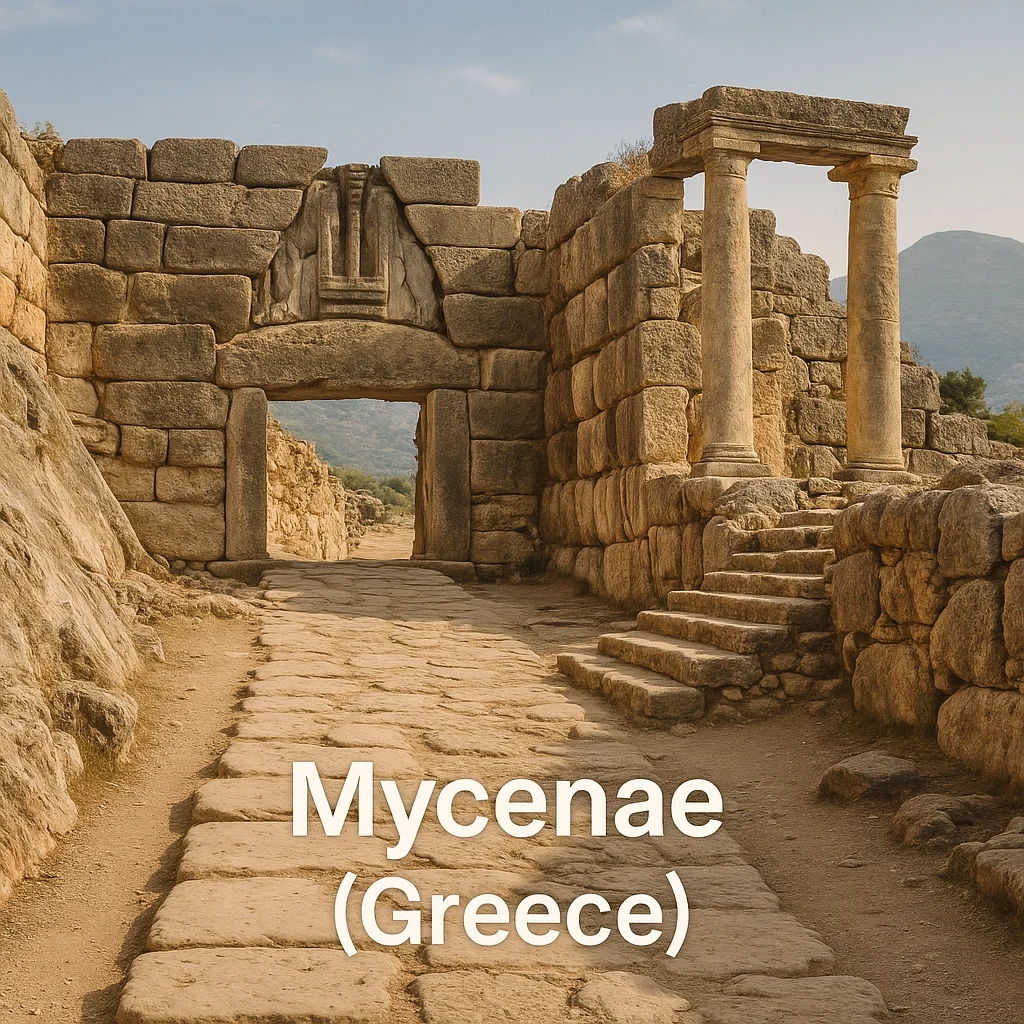
What makes Mycenae special is its historical significance as the heart of the Mycenaean civilization, which dominated the Greek mainland and Aegean from approximately 1600 BC to 1100 BC. The ruins offer a walkable experience through time, with expansive views of the surrounding valleys and hills.
Visitors can expect to immerse themselves in ancient history and archaeology as they explore the remnants of this once-powerful citadel. This guide will provide insights into the history, architecture, top highlights, and practical visitor information.
- Country/Region: Greece/Peloponnese
- Historical Era: Late Bronze Age
- Typical Visit Length: 2–4 hours
- Visit Difficulty: Moderate, with some steep paths
- Best Season: Spring and early autumn for mild weather
- Highlight: Lion Gate, Treasury of Atreus
🗺️ Where It Is and How to Orient Yourself
Mycenae is located in the northeastern part of the Peloponnese peninsula in Greece. It lies about 120 kilometers southwest of Athens, the capital city, making it accessible from the Athens International Airport.
Nafplio, a picturesque town nearby, serves as a convenient base for visitors. It's feasible to visit Mycenae as a day trip from Nafplio or Athens, though staying overnight in the area can enhance the experience.
The site is perched on a hilltop overlooking the fertile plains. This position offered strategic control over the land routes of the Peloponnese, lending Mycenae its historical power.
🕰️ History in a Nutshell
Mycenae was built by the Mycenaeans, a civilization that led Greek cultural development between 1600–1100 BC. This site served as a political and military stronghold, famous for its impressive fortifications and elaborate tombs.
Reaching its zenith during the 14th and 13th centuries BC, Mycenae played a key role in mythological tales, including the epic stories of the Trojan War. Over time, invasions and natural disasters led to its decline and abandonment.
The remaining ruins, such as the iconic Lion Gate, survived largely due to the durable construction methods of the ancient Mycenaeans, and archaeological efforts have brought much of it back to life today.
⭐ Top Highlights You Should Not Miss
- Lion Gate
- Royal Tombs (Treasury of Atreus)
- Palace Complex
- Grave Circle A
- Postern Gate
The Lion Gate is the main entrance to the citadel, famous for its massive stone structure and the relief of two lions above the doorway. From here, visitors can capture a full view of the gateway and the sprawling site beyond.
The Royal Tombs, known as the Treasury of Atreus, is a beehive-shaped structure that served as a royal burial site. The entire façade of this majestic tomb is visible from a distance, showcasing its grand entrance.
The Palace Complex offers insight into the administrative and residential hub of Mycenaean rulers. A wide view with the surrounding ruins in context can be observed from various elevated points around the citadel.
Grave Circle A is an important burial site within the walls, providing a glimpse into the funerary practices of the era. Visitors can see this landmark in full, set against the backdrop of the encircling hills.
The Postern Gate offers a sense of the defensive architecture that characterized Mycenaean fortifications, where one can view the surrounding landscape in all directions.
🧱 Architecture, Materials, and Design (Made Simple)
Mycenaean architecture is renowned for its use of massive stone blocks, known as "Cyclopean" masonry, which are fitted together without mortar. This construction method is a hallmark of their engineering prowess.
The style of Mycenae reveals influences from the Minoan civilization, especially visible in its palace structures and frescoes. The use of corbel arches in tomb construction, such as in the Treasury of Atreus, is a distinctive feature.
Unique architectural details at Mycenae include its monumental gates, such as the Lion Gate, and the engineering behind its underground cisterns. Modern restoration efforts have been undertaken to preserve these historical structures, with care taken to differentiate original elements from new additions.
🎟️ Visiting Guide (Time, Tickets, and What to Expect)
Visitors typically spend between 2 to 4 hours exploring Mycenae. While a brisk overview might take less than two hours, a deep dive into every corner and exhibit can occupy most of a day.
Entry to Mycenae encompasses both the main archaeological site and the nearby museum. Ticket pricing and hours can vary, and there are additional options for guided tours that enhance the visitor experience but should be booked ahead.
The site generally opens in the morning and closes by late afternoon, with possible seasonal variations. It's wise to check current patterns before planning. First-time visitors are advised to arrive early to avoid crowds and midday heat, bring water, and wear suitable footwear for uneven terrain.
🚆 How to Get There and Move Around
Travelers can reach Mycenae by public transport from Athens with a combination of train or bus services to the nearest town. Renting a car or joining a guided tour from Nafplio or Athens provides additional convenience.
The main entrance is straightforward for beginners, and a map provided at the site helps with orientation. Due to the nature of the ruins, those with mobility challenges should note the site has steep paths and uneven ground.
🌤️ Best Season, Weather, and Time of Day
The best time to visit Mycenae is during spring (March to June) and early autumn (September to October) when temperatures are pleasant, and the risk of rain is lower. Summer months can be hot and crowded.
Arriving in the early morning or late afternoon can provide cooler temperatures and an opportunity for better lighting, enhancing photographic opportunities. On rainy days, visitors may focus on the museum exhibits as an alternative.
⚠️ Safety, Rules, and Respectful Etiquette
Visitors should wear sturdy shoes suitable for walking on rugged paths and climbing steps. The site requests respectful behavior, especially in quieter areas and near sacred spaces.
Photography is generally allowed, though flash, drones, and tripods are usually restricted. It is vital to respect any posted signs about these rules.
Conservation efforts are in place, so visitors should avoid climbing on structures, touching carvings, and ensure all litter is disposed of properly. Heat and uneven pathways present the main risks, requiring cautious navigation.
🗺️ Nearby Places and a Simple One-Day Itinerary
Nearby attractions include the historical town of Nafplio, the ancient theater of Epidaurus, and the archaeological site of Tiryns. Nature lovers might enjoy the Argolic Gulf or Palamidi Castle with its panoramic views.
- Morning: Explore Mycenae site and museum.
- Midday: Lunch in the scenic town of Nafplio.
- Afternoon: Visit Epidaurus or Tiryns.
- Evening: Stroll along the Nafplio waterfront.
🧩 Stories, Myths, and Common Questions
Q: Was Mycenae really ruled by Agamemnon? A: While Agamemnon's reign is legendary, historians can't confirm its accuracy. However, the site matches descriptions in the "Iliad," adding to its mythic allure.
Q: Is Mycenae really a "lost city"? A: Mycenae was never "lost" in the sense of being unknown; rather, it underwent periods of decline and was rediscovered for archaeological study in modern times.
Q: Is the visit suitable for families? A: Yes, though the terrain may challenge younger children. Proper planning and supervision ensure a family-friendly experience.
Q: Are guides recommended at Mycenae? A: A guide can enrich your understanding of the complex history and nuances of the site, especially for those new to Mycenaean history.
📌 Summary and Who This Site Is Best For
- Mycenae, an ancient archaeological site of the late Bronze Age
- Located in the northeastern Peloponnese, Greece, near Nafplio
- Key history: center of Mycenaean civilization, linked to Homeric legends
- Top highlights: Lion Gate, Royal Tombs, Palace Complex
- Architecture: Cyclopean masonry, corbel vaulting, fortified structures
- Recommended visit: 2-4 hours, with time for adjacent museum
- Best season/time: Spring/early autumn, morning or late afternoon
- Safety/etiquette: Wear sturdy shoes, respect site rules, stay hydrated
- Nearby add-ons: Nafplio, Epidaurus, Tiryns, Argolic Gulf
- Memorable fact: Mycenae inspired key aspects of Greek mythology
Mycenae offers a richly historical experience suited to families, photographers, history buffs, and hiking enthusiasts. It stands as a testament to the Mycenaean civilization's influence on ancient Greek culture and lore.
With its captivating ruins and scenic backdrop, Mycenae is a destination worth the journey. It invites exploration and reflection on the past while urging visitors to tread respectfully and appreciate its historical depth.
Whether you're fascinated by ancient history or simply enjoy experiencing rich cultural sites, Mycenae provides both an educational and visually compelling visit.